
Rethinking Readiness
Steph Sharma
Founder, Symbio Strategies

June 12, 2026
6 min read
Share:


Before You Add Technology, Define the Change, the Impact, and What Your Organization Can Sustain
Your organization exists to support a key mission and purpose. This mission is what attracts and retains employees, leaders and patients. At the same time, it is experiencing pressures stemming from volatility, uncertainty, complexity and ambiguity causing deeper concerns about resources, capacity and viability.
You might be short-staffed. Margins are tightening. Your teams have more work than they have capacity for. Access to care is slipping.
The board has been asking what the health system is doing with AI. Peer organizations are moving ‘that direction’ in fear of being left behind. Multitudes of vendors with AI solutions are promising efficiencies, reduced cost, and improved outcomes. One solution could help ease scheduling, reduce burden on the access center with fewer patients lost between referral and care.
Leadership has green-lit an AI-enabled patient access solution. Maybe it is exactly the right technology. Now you have to make it work and yet you wonder if the organization is truly ready.
- Can the ‘patient access’ team change scheduling rules that are owned by individual clinics or service lines?
- Are the underlying data reliable enough to support the new process?
- Who handles exceptions when the technology does not fit the situation?
- What work is reduced, and what new work is created?
- Who has the authority to adjust the process once the technology is in use?
- How will you know whether the investment is actually improving access to care?
Increasingly, health systems are asking related implementation questions. HIMSS has focused attention on the increasing distance between AI pilots and operational deployment, including governance, implementation planning, clinician involvement, security, and workforce readiness. (HIMSS, 2026)
the opportunity for leadership is to take a systems approach to readiness.
Leadership support, technology, data, governance, workforce, and funding are all necessary conditions for implementation. And they are still only part of readiness.
readiness also has to be assessed against the change the organization is trying to make, the impact it expects the investment to produce, and what will be required to sustain the impact.
For the health system in our example, the objective is not to implement an AI-enabled scheduling tool. It is to improve access to care. The chosen technology is one part of the intended change.
When we use the word readiness in change efforts or technology integration initiatives we are part of, we mean the alignment among three things:
the change the organization is trying to make, the impact it expects to realize, and its ability to sustain the operating changes required to get there.
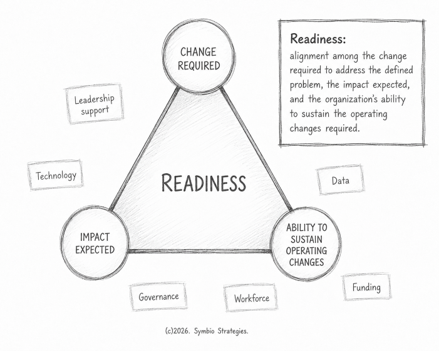
readiness is specific to the change
Consider the health system trying to improve patient access.
It may have strong executive sponsorship, an established governance structure, capable technology teams, and funding available for implementation. On paper, many of the usual readiness conditions are there.
With each affected component of the system (within this system) new considerations arise. Reducing call-center volume is one change. Giving patients more control over scheduling is another. Standardizing scheduling practices across service lines is another. Using automation to make or influence decisions that were previously made by people introduces yet another set.
Generally, a readiness assessment can tell us whether important capabilities are present. It does not often include an analysis of whether those capabilities are sufficient for the specific change being considered.
Weiner’s theory of organizational readiness describes readiness as both a shared commitment to a change and a shared belief in the organization’s ability to implement it. That belief is shaped by the demands of the specific change, the resources available to meet them, and the circumstances in which the work will occur (Weiner, 2009).
Healthcare technology research reaches a similar conclusion from another angle. The Nonadoption, Abandonment, Scale-up, Spread and Sustainability (NASSS) framework was developed to understand why health and care technologies are adopted, abandoned, scaled, or sustained. It looks beyond the technology itself to the condition or need being addressed, the people expected to use it, the organization, the value proposition, the wider environment, and how those elements change over time (Greenhalgh et al., 2017).
KEY TAKEAWAY
Insight: readiness can look very different inside the same organization.
A health system may be well prepared for one change and require substantially more preparation for another, depending on what the change asks of its people, operations, resources, and surrounding environment.
A health system may be well positioned to automate a repetitive administrative task with clear rules and ownership. The same system may need substantially more preparation before changing a patient-access process that crosses multiple specialties, alters decision authority, affects clinical capacity, and depends on inconsistent scheduling practices.
readiness is the degree to which an organization is prepared for a specific change, in a specific context, with a specific outcome in mind.
KEY TAKEAWAY
Insight: readiness can look very different inside the same organization.
pitfalls in assessing readiness
Potential pitfall
- Assessing the organization in general rather than for the specific change.
- Measuring capabilities without connecting them to the intended impact.
- Treating readiness as a one-time gate.
- Underestimating the operating changes around the technology.
- Stopping at launch.
Relevance
- A strong overall score can still hide weak fit for a particular workflow, service line, or operating model.
- Data, governance, sponsorship, and funding are most useful when considered in relation to the result the organization is trying to achieve.
- Some conditions need to be established before implementation; others develop through testing, learning, and adjustment.
- Roles, decision rights, staffing, workflow, capacity, incentives, and downstream demand can all shift.
- Readiness should include the organization’s ability to measure results, adjust the model, and sustain the change over time.
a technology decision becomes an operating decision
Suppose the health system moves forward with the patient-access solution.
The technology may make it easier for patients to find and schedule appointments. That sounds like an access improvement. Yet the moment the process changes, other parts of the organization (system) begin to move with it.
A clinic that previously controlled its own scheduling rules may need to give the access team greater authority. Appointment templates may need to change. Physicians may see a different mix of patients. Call-center work may decline in one area and increase in another. Faster scheduling may expose a shortage of specialty capacity that was previously hidden by the scheduling bottleneck itself.
the technology can solve one constraint and reveal the next.
If the goal is improved access to care, success depends on more than whether patients can book an appointment. It may depend on time to appointment, referral completion, available clinical capacity, staffing, scheduling accuracy, patient experience, and whether the organization can respond when demand shifts. For the patient, access is whether the right care is available, reachable, and timely, not simply whether an appointment can be booked.
Systems-change research describes this wider landscape in terms of practices, resource flows, relationships, power, and the assumptions that shape how organizations operate (Kania, Kramer and Senge, 2018). A change in one part of the system can alter responsibilities, decisions, resources, and relationships elsewhere.
For a leader evaluating the investment, they might ask:
- What will need to work differently across the organization for this investment to improve patient access?
- That question moves the conversation beyond implementation and back to the outcome the organization is trying to achieve.
readiness is built before and through the work
Before the health system in our example begins change-oriented work, several conditions need to be established.
Leaders need a clear definition of the access problem they are trying to solve, executive sponsorship, ownership of the work, enough understanding of current workflows and constraints to anticipate where the change will land, and agreement on how they will judge whether the investment is improving access.
From this problem-defining inquiry, they realize a sound starting point
Implementation then adds information that an assessment alone cannot provide.
Leaders begin to see which scheduling exceptions occur most often, where demand shifts, which teams need greater authority, what new work is created, and which measures best reflect whether access is actually improving. And that learning is happening while the same teams are still running clinics, managing access problems, and fulfilling the organization’s improvement work.
Some readiness is established before the work begins. Additional capability is developed through adaptive testing, learning, and adjustment.
Research on systems change describes this as adaptive capacity: the ability to gather new information, recognize connections, and adjust as conditions change (Gopal and Kania, 2015). That capability becomes especially important when the work crosses functions, introduces new decision pathways, or reveals constraints that were difficult to see in advance.
We have seen this in practice. In work with a Federally Qualified Health Center during and beyond COVID, leaders had to revisit assumptions that had once served the organization, bring more perspectives into decisions, and use practical indicators to see where change was taking hold and where further calibration was needed. The implementation itself became part of how readiness developed.
More recent systems-change work makes a similar argument: the capacity to sustain change can be treated as an outcome in its own right, alongside the results the initiative is intended to produce (Misra and Guerrero, 2024).
For leaders, three questions help distinguish what needs to happen when:
- What needs to be in place before we begin?
- What can we learn through implementation?
- What evidence do we need before we expand?
This gives leaders a clearer basis for deciding when to proceed, when to adjust, and when the organization is prepared to scale.
The goal is to build enough capability through the work that the organization can sustain the change, continue learning, and adjust as conditions evolve.
assess before prescribing, measure what remains
Return to the health system trying to improve patient access.
At this point, the question moves beyond ‘which scheduling technology to buy.’ Leaders have a clearer view of the access problem, the operating changes involved, the dependencies across the system - clinics and service lines, and the conditions that will influence whether the investment produces the expected result.
Before selecting the path, leaders can bring those pieces together.
In our work at Symbio , we use a Step 0 assessment to look at the need being addressed, leadership and operating readiness, current technology and data, available investment, and what will be required to sustain the change. The goal is to recommend a path that fits the organization as it is today, fosters an adaptive learning environment, and better ensures the result it is trying to achieve.
That may mean moving forward. It may mean narrowing the scope. It may mean sequencing the work differently. It may also mean strengthening a few conditions first so the investment has a better chance of delivering what leaders expect from it.
Keep measuring after launch.
Three, six, and 12 months later, ask:
- Are patients getting to care faster
- Are fewer referrals being lost along the way?
- Has unnecessary administrative work decreased?
- Can leaders see where the process is working and where it needs adjustment?
- Can the organization make those adjustments as conditions change?
- Is the investment continuing to produce value?
A successful implementation is only part of the story. Beyond that, the organization understands what changed, can see whether the change is helping, and has the ability to keep adjusting it over time.
For leaders, readiness should make the next decision more apparent. It should help separate what needs to happen now from what can be learned through the work, and give the organization a better chance of turning a promising investment into sustained impact.
question for leadership
Before choosing or scaling a technology, can you clearly define the change you expect it to create, the impact you expect to realize, and what the organization will need to sustain that change over time?
references
Gopal, S. and Kania, J. (2015) ‘Fostering Systems Change’, Stanford Social Innovation Review. doi: 10.48558/ZNGZ-0210.
Greenhalgh, T., Wherton, J., Papoutsi, C., Lynch, J., Hughes, G., A’Court, C., Hinder, S., Fahy, N., Procter, R. and Shaw, S. (2017) ‘Beyond adoption: A new framework for theorizing and evaluating nonadoption, abandonment, and challenges to the scale-up, spread, and sustainability of health and care technologies’, Journal of Medical Internet Research, 19(11), e367. doi: 10.2196/jmir.8775.
Kania, J., Kramer, M. and Senge, P. (2018) ‘The Water of Systems Change’, Stanford Social Innovation Review, 16(2), pp. 32–38.
Misra, S. and Guerrero, M. (2024) ‘Investing in Systems Change Capacity’, Stanford Social Innovation Review, 24 January. doi: 10.48558/4HFX-K118.
Ramage, N. (2026) ‘From Pilot to Production: AI Governance, Risk, and Readiness Across Global Healthcare’, HIMSS, 17 June.
Weiner, B.J. (2009) ‘A theory of organizational readiness for change’, Implementation Science, 4, Article 67. doi: 10.1186/1748-5908-4-67.
Steph Sharma
Founder, Symbio Strategies
Steph advises senior leaders in healthcare, leadership governance, and decision systems. She founded Symbio Strategies in 2018.
IN THIS ARTICLE
RELATED PRACTICE
Decision Systems and Strategy
Surface where decisions are stalling and build the system to move them.
FACING THIS CHALLENGE?
Start a conversation with Symbio. Thirty minutes. We listen first.
RELATED READING
from the same practice.

READY TO TALK?
start with a conversation.
Thirty minutes. We listen first.