
The Rural Health Distance Difference
Steph Sharma
Founder, Symbio Strategies

June 12, 2026
6 min read
Share:


Distance is easy to measure. Timely access to the care needed is much harder to see.
Imagine a pregnant patient living in a rural community. Her blood pressure has been rising. The nearest place she can receive basic care is about an hour away and the hospital equipped to provide the level of obstetric care she could need in the case of an emergency is about three hours away.
Those distances are easy to put on a map. What the map cannot tell us is whether her changing condition will be recognized early enough. Whether the clinician closest to her has access to obstetric expertise. Whether someone knows when the situation has crossed from something that can be managed locally to something that requires transfer. Whether transportation can be arranged quickly. Whether the receiving hospital has capacity. Whether the information needed to make those decisions moves as quickly as the patient needs it to.
Distance is a part of rural healthcare. More than half of rural U.S. counties lack hospital obstetric services, and rural patients have to travel substantially farther for labor and delivery care than patients in urban communities (HRSA, 2026; March of Dimes, 2026). The way a health system prepares for and manages that distance can be very different from one community to another.
Two patients can live the same three hours from specialty care on different points on a map and experience very different paths.One may have an early warning sign identified close to home, receive immediate access to specialty guidance, a clear escalation plan, coordinated transport, and a receiving team already expecting her. While another may travel exactly the same distance after the problem has become an emergency.
This is a prime example of what we mean by the ‘rural health distance difference’: how well the system recognizes need, maintains connection, and gets a patient to the right care across the distance that already exists.
ambiguity of true need
Distance and drive time are useful measures of geographic access. Distance tells us how far a patient must travel; estimated drive time adds context about how long that journey may take. Both can help identify communities with limited proximity to needed services and significant travel burdens. Actual travel time can vary with road conditions, weather, traffic, terrain, transportation availability, and time of day. Together, these measures can help identify geographic isolation, long travel requirements, and areas with limited proximity to specialty care.
They tell us far less about whether the patient’s need will be recognized, whether the available setting has the capability required, whether specialty expertise can be reached, or whether information and responsibility will move with the patient.
Federal rural maternal-health programs reflect this broader view by emphasizing coordinated networks, risk-appropriate care, specialty access, telehealth, and continuity across settings (HRSA, 2026).
The same is true across other clinical needs within a rural care setting. A patient with stroke symptoms, chest pain, a concerning cancer finding, or worsening behavioral health needs may live far from specialty services. The distance itself may be fixed. The system’s ability to recognize, connect, escalate, and coordinate across that distance is far more variable.
A mileage map cannot tell us how well the system is prepared to manage everything that has to happen to serve the patient's needs, across that distance.
follow the patient across the distance
The rural health distance difference becomes easier to see when we stop looking only at facilities and follow the patient instead.
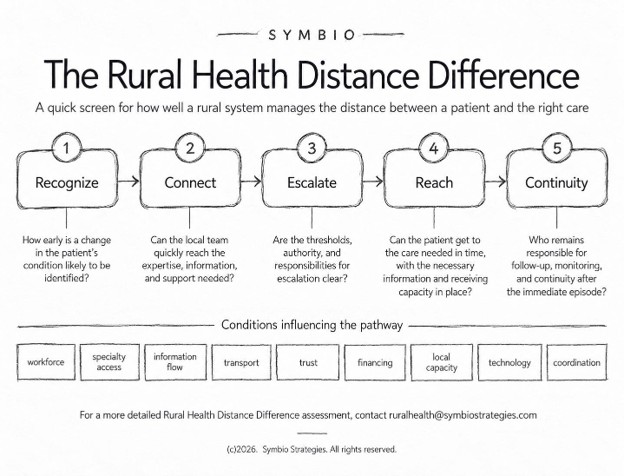
For a pregnant patient, the path to the right care begins long before a transfer. Someone has to recognize that her condition may change, or is changing. The local team has to know when specialty input is needed. That expertise has to be reachable. The escalation plan has to be clear. Transportation and receiving capacity have to line up. Her clinical information has to move with her. And once the immediate episode is over, someone still needs to know what happens next.
Each step can either help manage the distance or add delay to it. A systems view looks at how the parts of a system interact, how information and resources move between them, and how changes in one part can produce effects elsewhere (Meadows, 2008). Rural health programs already reflect pieces of this systems view. HRSA’s Rural Maternity and Obstetrics Management Strategies program emphasizes coordinated networks across the continuum of care, telehealth and specialty access, and financial sustainability. Similarly, AHRQ points to specialty consultation networks and stronger links between rural hospitals and larger medical centers as ways to improve timely diagnosis and treatment (HRSA, 2026; AHRQ, 2026).
The same pathway applies here beyond maternity care to other clinical care paths.
The Rural Health Distance Difference Assessment
Note: For the full Rural Health Distance Difference Assessment, contact ruralhealth@symbiostrategies using the link below.
Where that pathway weakens, distance becomes harder to manage. A workforce shortage can delay recognition. Limited specialist access can slow a decision. An unclear transfer relationship can add hours after the need for higher-level care is already known. Fragmented information can force the receiving team to start again. Transportation can become the limiting factor even when the clinical plan is clear. And any of these can happen at once.
That is why rural access cannot be understood only by asking where services are located. We also need to understand how people, information, decisions, and responsibility move between them. One path shows early recognition, connected expertise, clear escalation, coordinated transfer, and continuity. The other shows the same three-hour geography with delayed recognition, fragmented escalation, and care arriving later.
For leaders: How reliably can our system recognize what a patient needs and move them toward the right care across that distance?
technology can compress distance. It cannot replace the system.
Technology can change what three hours means.
A virtual specialty consultation can bring expertise into a local clinic without asking the patient to make the trip. Remote monitoring can make a change in blood pressure visible between visits. Secure messaging or telephone follow-up can create another point of contact. Digital navigation can help a patient understand where to go next and what to do when circumstances change.
The evidence supports that promise. Reviews of rural digital health and telehealth have found benefits including improved access to clinicians and specialists, reduced travel burden, better continuity for some conditions, and expanded use of remote monitoring and virtual consultation (Maita et al., 2024; Lobaina et al, 2026). The benefit depends heavily on how the technology is connected to the local care system. Rural clinicians themselves have described substantial potential for telemedicine to improve specialty access while also pointing to the importance of local need, participating specialists, administrative support, and the way virtual care fits into rural practice (Butzner and Cuffee, 2024).
For a patient with rising blood pressure, a remote reading only helps if someone receives it, knows what requires action, has the authority to respond, can reach the appropriate clinician, and has somewhere to send the patient when a higher level of care is required.
Technology can shorten the distance to information and expertise. It can create contact where geography makes contact difficult. It can help a rural clinician reach specialty support without moving the patient first. Clinical capacity, judgement, ownership, transfer relationships, staffing, financing, and trust still have to exist around it.
Recent evidence on rural virtual care reaches a similar conclusion: telehealth is most effective when it is integrated into locally anchored systems of care, with clear clinical responsibility, escalation pathways, infrastructure, and support for both patients and clinicians (Patel et al., 2026).
For the rural health distance difference, technology becomes valuable when we can say specifically which part of the patient’s path it is shortening, strengthening, or making more visible, and what has to be in place around it for that benefit to reach the patient.
Technology can change what three hours means. It can shorten the distance to information and expertise by creating contact where geography makes contact difficult thus helping rural clinicians reach specialty support without having to move the patient first. A virtual specialty consultation can bring expertise into a local clinic without asking the patient to make the trip. Remote monitoring can make a change in blood pressure visible between visits. Secure messaging or telephone follow-up can create another point of contact. Digital navigation can help a patient understand where to go next and what to do when circumstances change.
The evidence supports that promise. Reviews of rural digital health and telehealth have found benefits including improved access to clinicians and specialists, reduced travel burden, better continuity for some conditions, and expanded use of remote monitoring and virtual consultation (Maita et al., 2024; Lobaina et al, 2026). The benefit depends heavily on how the technology is connected to the local care system. Rural clinicians themselves have described substantial potential for telemedicine to improve specialty access while also pointing to the importance of local need, participating specialists, administrative support, and the way virtual care fits into rural practice (Butzner and Cuffee, 2024).
For a patient with rising blood pressure, a remote reading only helps if someone receives it, knows what requires action, has the authority to respond, can reach the appropriate clinician, and has somewhere to send the patient when a higher level of care is required.
Recent evidence on rural virtual care reaches a similar conclusion: telehealth is most effective when it is integrated into locally anchored systems of care, with clear clinical responsibility, escalation pathways, infrastructure, and support for both patients and clinicians (Patel et al., 2026).
For the rural health distance difference, technology becomes valuable when we can say specifically which part of the patient’s path it is shortening, strengthening, or made more visible, and what has to be in place around it for that benefit to reach the patient. Clinical capacity, judgement, ownership, transfer relationships, staffing, financing, and trust still have to exist around it.
a rare investment window
The Rural Health Transformation (RHT) Program changes the scale of what is possible.
All 50 states are receiving awards through the $50 billion program, with $10 billion available each year from fiscal year 2026 through 2030. First-year awards average about $200 million per state. CMS has framed the program around expanding rural access, strengthening the workforce, modernizing infrastructure and technology, and advancing innovative, sustainable care models (CMS, 2025; CMS, 2026).
States now have resources to address several of these conditions at the same time. States can invest in workforce and specialty access, digital infrastructure, regional coordination, new care models, and the systems that help information and responsibility move with the patient. The program itself is structured as a five-year effort, with annual continuation requirements and ongoing CMS oversight during implementation (CMS, 2026).
With that level of investment, the question becomes how do the pieces work together? And how well do they work together?
A new telehealth platform may increase access to expertise. A workforce initiative may add needed capacity. A regional network may improve referral or transfer options. Each can contribute something important. An agentic AI solution may solve for workforce and access gaps. The key to this opportunity is to connect those investments around the patient’s path.
For the pregnant patient, that would mean asking whether the combined investments make it more likely that rising risk is recognized earlier, specialty expertise is available sooner, escalation is clearer, transfer is coordinated, and continuity remains intact after the immediate episode.
Will the investment add individual programs and capabilities, AND will it also change how reliably a patient reaches the right care in time?[
key questions for leaders in rural health transformation
Return to the patient who lives three hours from higher-level obstetric care. While the distance remains three hours, proper planning can change everything that happens before, during, and after that trip.
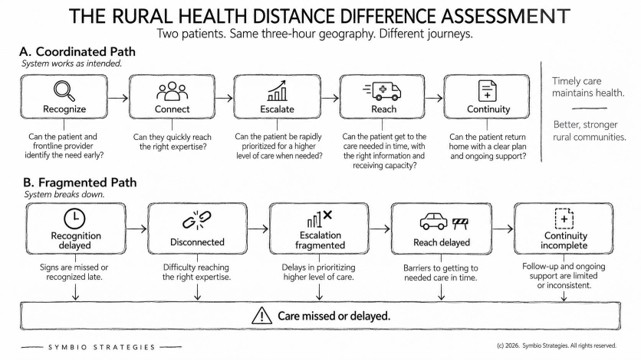
Was the rising risk recognized early, and documented in a shared record? Did the local clinician have access to that information and to the right specialist/s? Was there a clear plan for escalation? Could the receiving team prepare before the patient arrived? Did the necessary information move with her? After the immediate episode, who remained responsible for follow-up?
Those questions can also guide broader rural-health investment decisions.
For leaders:
- 1. Where in the patient’s path does the current system break down?
- 2. How early is a change in condition likely to be recognized?
- 3. Who owns escalation and transfer?
- 4. Where does specialty capability enter the pathway?
- 5. What happens when physical transfer is delayed?
- 6. Does the information needed for the next decision move with the patient?
- 7. Who remains connected to the patient between encounters?
- 8. How will we know the investment changed access to the right care?
Rural transformation will look different across communities because the distances, resources, workforce, and local relationships are different. The patient’s path gives leaders a way to see how those pieces work together.
When distance is unavoidable, the system should be designed to recognize need early, connect the right people and information, and move the patient toward the right care in time.
For the patient, that is the difference distance makes.
Our more comprehensive Rural Health Distance Difference Assessment[3.1][4.1] examines the operating conditions, dependencies, and risks across each stage of the patient pathway. Contact us at Symbio Strategies to learn more.
Author info:
references
Centers for Medicare & Medicaid Services (CMS) (2025) ‘CMS Announces $50 Billion in Awards to Strengthen Rural Health in All 50 States’, 29 December.
Centers for Medicare & Medicaid Services (CMS) (2025) ‘CMS Announces Establishment of the Office of Rural Health Transformation’, 29 December.
Centers for Medicare & Medicaid Services (CMS) (2026) Rural Health Transformation: Frequently Asked Questions, 9 April.
Health Resources and Services Administration (HRSA) (2026) ‘Rural Maternity and Obstetrics Management Strategies (RMOMS) Program’, U.S. Department of Health and Human Services.
Hampton, F., Larson, J., Hobson, A. and Hughes, D. (2024) ‘The role of telemedicine in rural specialty care: Priorities and recommendations from rural primary care physicians’, Kansas Journal of Medicine, 17(1), pp. 6–10. doi: 10.17161/kjm.vol17.21290.
Lobaina, D., Llorens, C., Eldawy, N., Kosseifi, G., Puvvala, A., Srivastav, M., Miron, E., Frishman, M., Nasr, M., Jhumkhawala, V., Jimenez, S., Etzel, M., Knecht, M., Mejia, M. and Sacca, L. (2026) ‘The role of telehealth in decreasing barriers in accessing primary and specialized care services in U.S. rural and underserved communities: A scoping review’, Telemedicine and e-Health, 32(8), pp. 811–826. doi: 10.1177/15305627261443159.
Maita, K.C., Maniaci, M.J., Haider, C.R., Avila, F.R., Torres-Guzman, R.A., Borna, S., Lunde, J.J., Coffey, J.D., Demaerschalk, B.M. and Forte, A.J. (2024) ‘The impact of digital health solutions on bridging the health care gap in rural areas: A scoping review’, The Permanente Journal, 28(3), pp. 130–143. doi: 10.7812/TPP/23.134. March of Dimes (2026) Nowhere to Go: Maternity Care Deserts Across the U.S. 2026
report.
Meadows, D.H. (2008) Thinking in Systems: A Primer. White River Junction, VT: Chelsea Green Publishing.
Steph Sharma
Founder, Symbio Strategies
Steph advises senior leaders in healthcare, leadership governance, and decision systems. She founded Symbio Strategies in 2018.
IN THIS ARTICLE
RELATED PRACTICE
Decision Systems and Strategy
Surface where decisions are stalling and build the system to move them.
FACING THIS CHALLENGE?
Start a conversation with Symbio. Thirty minutes. We listen first.
RELATED READING
from the same practice.

READY TO TALK?
start with a conversation.
Thirty minutes. We listen first.